


Another sleepless night, spent tossing and turning for hours?
When you’ve had fewer than seven hours of sleep, you don’t perform at your best, physically or mentally.
Many chronically sleepless patients are concerned about long-term brain health. Fueled by media reports, they fear a pattern of insufficient sleep heightens their risk of some form of dementia. They wonder: Is insomnia a symptom of dementia? Does lack of sleep cause Alzheimer’s?
Although several observational studies find a definite connection between sleep and dementia, your insomnia won’t necessarily cause dementia in your later years.
Can Insomnia Cause Dementia?
Some interesting studies look not just at sleep quantity but also at the quality of sleep you get.
During deep sleep, the ventricles of your brain experience a rhythmic pumping action that clears away the toxic debris accumulated during your waking hours. The more time spent in deep sleep, the more thorough the clearing.
This debris includes beta-amyloid plaques, a buildup that, if left unchecked, may contribute to Alzheimer’s disease and Parkinson’s-related dementia.
So, brain health may rely not only on the amount of sleep you get but also on the quality of your sleep and how well your REM and deep-sleep stages recharge you.
Medical science hasn’t yet found that poor-quality sleep causes forms of dementia.
Is Insomnia a Symptom of Dementia?
Interestingly, many people suppose that insomnia is just a byproduct of aging, and that the older we get, the less we sleep. But all things being equal, the sleep architecture of most older adults is quite similar to that of younger ones.
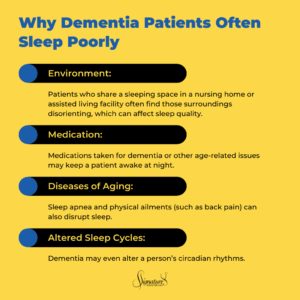
However, people with dementia in particular often experience poorer-quality sleep. Here are some reasons dementia patients don’t sleep well:
- Environment: Patients who share a sleeping space in a nursing home or assisted living facility often find those surroundings disorienting, which can affect sleep quality.
- Medication: Medications taken for dementia or other age-related issues may keep a patient awake at night.
- Diseases of Aging: Sleep apnea and physical ailments (such as back pain) can also disrupt sleep.
- Altered Sleep Cycles: Dementia may even alter a person’s circadian rhythms. For these people, at 3 a.m., the part of the brain that should signal sleep time might instead say, “It’s time to wake up, brush your teeth, and go to work.”
Sleep apnea can also affect an individual’s ability to get uninterrupted rest, regardless of age. If you have apnea, good-quality sleep is rare. You may sleep 10 hours a night yet wake up exhausted because your brain thinks it didn’t sleep at all.
Studies show sleep apnea increases a patient’s risk for vascular dementia by 25% over their baseline risk. Here’s why:
- Reduced oxygen levels in the bloodstream impair the brain’s critical oxygenation, while decreased blood flow damages brain tissue.
- With apnea typically linked to obesity, the patient may be fairly inactive and have comorbidities like hypertension or high cholesterol, all independent risk factors for vascular dementia.
Should You Worry About Sleep and Dementia?
If you’re between 30 and 50 with chronic insomnia, you may wonder whether six hours of sleep a night puts you on a path toward dementia at 65.
The baseline risk of dementia is about 10%. Contributing factors like chronic poor sleep may raise that risk by 30%, which sounds alarming until you do the math: a 30% relative increase on a 10% baseline adds approximately three percentage points of absolute risk.
No controlled studies have yet examined whether treating insomnia directly lowers dementia risk. But that research gap isn’t a reason to shrug. The factors that drive poor sleep in midlife, whether a stay-up-late lifestyle, untreated health conditions, or behavioral issues, are themselves independent risk factors for dementia.
Sleep disruption and cognitive risk often share the same roots. For a smaller subset of people, genetics plays a role as well: some adults are predisposed to develop dementia regardless of lifestyle.
Optimizing the variables within your control is worth doing, with or without a proven direct sleep-dementia link. The habits that support good sleep reduce cognitive risk through pathways we understand well.
My advice to patients:
- Eat healthy.
- Exercise consistently.
- Engage regularly in enjoyable social interactions.
- Try your best to sleep the seven to nine hours a night your body needs.
- Keep your sleep window (the time you go to bed and the time you awaken each morning) the same each day, within about 60 minutes.
Sleep-Deprived? Here’s When to Talk to Your Doctor
Despite your best efforts, you may find you still can’t sleep well. If lack of sleep affects your home, work, lifestyle, or general ability to function well, here’s what I recommend:
- Discuss sleep patterns with your Signature Healthcare doctor at your annual physical exam. In addition to your baselines and key vital signs, we’ll consider your sleep quality and quantity, exercise routine, diet, mood, and behavioral factors.
- Between physicals, schedule time with your physician if you see marked changes in daily energy levels. We’ll help you distinguish between sleeplessness and fatigue caused by other factors. A sleep study may help.
- We’ll counsel you on proper sleep hygiene and may also advise cognitive-behavioral therapy or supportive mindfulness and meditative practices.
- Consult your physician before taking any sleep aids, whether OTC or prescription. With an informed view of your lifestyle, we’ll determine if or when a sleep aid might help you achieve the slumber you need, safely and efficiently.
Seeking a restful, restorative good night’s sleep? Concerned about brain health? Still questioning, “Does lack of sleep cause Alzheimer’s?”
Your Signature Healthcare team will help rest your mind. Contact us today.
Topics: