

Testosterone replacement therapy helps many men recapture the vitality, confidence, and vigor they had before their testosterone (T) levels dipped. But not every T therapy suits every routine.
Today, some men are turning to testosterone pellets, frequently promoted by clinics claiming to specialize in hormone replacement therapy (HRT).
A brief outpatient procedure implants six to 10 rice-sized pellets under the patient’s skin, typically in the hip or buttock area. Then, over the course of three to six months, the testosterone pellets slowly release bioidentical testosterone into the patient’s bloodstream.
This slow release is likely the reason for the pellets’ popularity. Time-wise, the procedure may seem more convenient to the patient than a weekly injection or daily application of a testosterone gel.
Testosterone pellets receive positive ratings from patients: 70% say they’re satisfied with their results. (And those provider clinics are often satisfied with their recurring revenue from the procedure.)
But at Signature Healthcare, testosterone pellets are not our first choice.
Medically Approved Management of Low Testosterone
We prefer to follow other common, medically proven delivery methods to elevate low T levels:
- For most patients, I prescribe a supplemental testosterone gel that patients simply apply to their upper arms or shoulders after their daily shower.
- Alternatively, we can deliver an intramuscular testosterone injection every one or two weeks here in our offices. Or, a patient may choose to self-administer the shot at home. T levels tend to be highest post-injection, decreasing until the next injection. As levels fluctuate, the patient may experience mood shifts or swings.
Topical gel and muscular injection are equally successful in treating patients’ low-T symptoms.
Do You Really Need More Testosterone?
An increasing number of men are taking supplemental testosterone to feel younger and more vital. And some experts argue, why shouldn’t men enhance their T levels if it makes them feel better?
But I worry that many males see testosterone supplementation as a fountain of youth, when essentially, it’s a critical hormone with potential side effects in larger doses. There’s a significant safety difference between addressing a diagnosed testosterone deficiency and simply upping testosterone for lifestyle or anti-aging purposes.
A patient who wants to encourage youth and vitality must accept that there may be tradeoffs and risks in enhancing testosterone levels.
Likely candidates for testosterone replacement therapy are adult males found to have measurably low T levels after at least two rounds of testing.
During testing, I also want to determine why a patient’s level is low. Many males simply don’t make as much testosterone as they did in their younger years. However, in others, pituitary or other health issues may affect T levels.
In those cases, it makes sense to treat the underlying issue rather than just reflexively replace testosterone.

Effects of Too Much Testosterone
I’m concerned when I see a patient dose with unnecessary amounts of testosterone: what we call supra-physiologic or supra-therapeutic levels that exceed an advisable range.
Just like any other medication or hormone, too much testosterone can create problems:
- It may cause excess body hair or cause skin conditions such as acne or hidradenitis suppuritiva.
- Large fluctuations in T levels can cause moodiness.
- Extra levels of testosterone may exacerbate sleep apnea.
- High T levels can lead to increased red blood cell production, a potentially harmful condition known as erythrocytosis. In extreme circumstances, this thickens the blood, making it harder to circulate.
- Over time, men who excessively supplement testosterone may develop Benign Prostatic Hyperplasia (BPH), an enlarged prostate, more quickly than they otherwise would. Supplementation may hasten the growth of a tiny, smoldering prostate cancer that’s not yet found.
- Although controversial, certain experts continue to indicate concern over whether excessive T levels may increase the risk of cardiovascular issues.
A word about women and testosterone supplementation: Although females generally don’t require testosterone supplementation, some women’s experts claim they can benefit from it as well (at a much lower dose than men).
However, in women, some testosterone is converted back into estrogen, and excess estrogen can encourage breast and ovarian cancer. It’s an area of concern that’s still being studied.
How We Check Testosterone Levels
To check your levels of testosterone, I generally follow this process:
- At an initial appointment, I check your T levels prior to 10 a.m., when they’re most reliable.
- If this baseline screen shows low testosterone, we schedule you for more intensive testing, looking at total testosterone and free or bioavailable testosterone.Some of the testosterone in your system will stick to proteins. I want to see how much is unbound to proteins and can interact with the cells in your body. I’ll also measure some of the proteins that do bind to testosterone to ensure they’re not affecting T levels.
- I’ll check that your pituitary and other hormone levels are robust and producing well. I may look at your iron, too, as hemochromatosis can also cause low testosterone.
If this deeper level of testing shows no definitive cause of the low testosterone, I’ll likely move to replace it.
I primarily recommend the topical (gel) treatment to address testosterone deficiency. It tends to work well, and it can be easily tailored to your symptoms and modified throughout treatment.
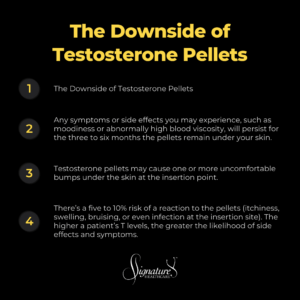
The Downside of Testosterone Pellets
Occasionally, a patient will inquire about those testosterone pellets to treat low T levels. As noted, pellets are somewhat effective, but they come with a downside:
- Pellets lack FDA approval for many uses.
- Once inserted beneath your skin, testosterone pellets can’t easily be removed. Any symptoms or side effects you may experience, such as moodiness or abnormally high blood viscosity, will persist for the three to six months the pellets remain under your skin. I’ve had patients who needed to donate blood to deplete an excess of red blood cells that created a clotting risk.
- Testosterone pellets may cause one or more uncomfortable bumps under the skin at the insertion point.
- There’s a five to 10% risk of a reaction to the pellets (itchiness, swelling, bruising, or even infection at the insertion site). The higher a patient’s T levels, the greater the likelihood of side effects and symptoms.
Because gel and injection therapies rarely cause such issues, it’s prudent to first try those approved options to supplement testosterone.
Closing Thoughts on Testosterone Pellets
Medical professionals are trained not to cause harm to the patient. At Signature Healthcare, we believe it doesn’t make sense to expose patients to added risk.
When it comes to managing low T levels, it’s important to distinguish between responsible healthcare and compelling marketing. Here’s our advice:
- Be cautious of hormone replacement clinics. You want to treat a testosterone deficiency with proper therapy, not simply trust procedures you think might make you feel better.
- Be wary of testosterone pellets. Once inserted, they may cause you irreversible side effects for three to six months.
Ready to speak with us about potentially low testosterone levels? We’re ready to listen.
Topics: