

Back when I made hospital rounds, staff would often report to me that a particular patient’s vital signs were “stable.” But the interesting thing is, vitals are only truly stable if a patient is deceased!
Joking aside, in those of us who are very much alive, vital signs fluctuate constantly. Many aspects of day-to-day life can affect our body temperature, pulse rate, respiratory rate, and blood pressure, minute to minute, or even second by second. It’s completely normal to see blood pressure fluctuate throughout the day as your body responds to activity, stress, and even small changes in posture.
If you use a device to monitor your blood pressure at home, perhaps you occasionally notice your pressure fluctuating in this way. And soon you’re asking, “Why does my blood pressure fluctuate so much within minutes? Is it something to worry about? Should I review my readings with my physician?”
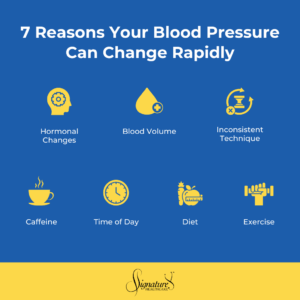
Why Blood Pressure Can Change Rapidly
Blood pressure varies because of these factors:
- Hormonal changes: Rapid fluctuations can result from brief, natural shifts in adrenaline and cortisol levels in response to external stimuli and your frame of mind. For a habitually anxious person, even checking their blood pressure can spike it!
- Blood volume: Your blood volume and density can shift throughout the day; for instance, if you become a bit dehydrated from working in the yard.
- Inconsistent technique: If you check your blood pressure with an at-home monitor, consistent technique is key. If your posture varies each time (sometimes you sit, sometimes you stand), so might your readings.
- Caffeine: If you don’t consume caffeinated drinks regularly, an occasional shot of caffeine probably makes your blood pressure soar briefly.
- Time of day: Your highest blood pressure readings usually occur very early in the morning, when your body experiences a cortisol surge. As the day wears on, readings level off.
- Diet: Immediately after you eat, blood pressure typically drops slightly as blood flow is directed to your digestive system. But foods high in salt, especially processed foods, can cause you to retain fluid, increasing blood volume and raising blood pressure.
- Exercise: Your blood pressure heightens during a workout as your heart pumps harder to deliver oxygen to your muscles. Pressure then typically decreases after exercise, sometimes even falling to a level slightly below your pre-exercise resting rate.
A Reliable Blood Pressure Reading
In our offices, blood pressure readings are precise and reliable. We use a stethoscope and a manual cuff to obtain the most accurate readings, rather than relying on automatic cuffs linked to a machine.
If you routinely use an at-home device to measure your own blood pressure and you’re wondering, “Why does my blood pressure fluctuate so much within minutes?” here are some tips to capture accurate results:
- Be sure your blood pressure monitor is correctly calibrated. You can bring your monitor to your next visit. We’ll verify if it aligns with our readings.
- Seat yourself comfortably and calmly for five minutes before you take your reading.
- Keep your feet flat on the ground and your arms on an armrest just below chest height.
- Wrap the cuff around your upper arm, not your wrist. Be sure it’s the proper size for your arm, not too tight or too loose.
When to See Your Doctor
So, when is it important to act if blood pressure fluctuates?
Perhaps a patient discovers their pressure spiking at 140/80 at bedtime and worries a stroke is imminent. But the brain can effectively protect itself against an occasional excursion into a systolic pressure of 180 to 200, particularly if the patient has a history of high blood pressure.
In my experience, it’s the patient whose systolic blood pressure is typically in the normal range (100-120 mmHg) but suddenly spikes to 200 who I want to see immediately.
Of course, the lower extreme is also true: If a patient’s blood pressure is normally 120/80 (the upper limit of normal), they may call me if it suddenly drops to 80/50. If I learn they’re not dizzy, faint, short of breath, or having chest pain, their body is very likely tolerating that sudden, brief blood pressure fluctuation.
Making an Informed Decision
When I review fluctuations in your blood pressure, I focus on both your systolic reading (the top number, showing the pressure in your arteries when your heart beats) and the diastolic reading (the bottom number, indicating the pressure when your heart rests between beats). But I also consider your heart rate, the time of day fluctuations occur, and the circumstances surrounding their occurrence, among other factors.
For most people, immediate intervention isn’t needed. I like to make an informed decision on whether to add, intensify, or decrease medications and will not reflexively make changes based on just a couple of days’ worth of readings. I’ll ask you to measure your blood pressure at home for a set period and will take action if it doesn’t reset naturally.
If you have questions about your blood pressure, including “Why does my blood pressure fluctuate so much within minutes?” your Signature Healthcare team is here to help.
Bring your questions to us about why your blood pressure fluctuates. Let us put your mind at ease.
Topics: