


If you know someone with advanced pancreatic cancer, you’ve likely heard their prognosis is poor.
Soberingly, once the disease spreads, only about 13% of patients can expect a five-year survival rate. And even localized pancreatic cancer (that is, confined to the pancreas) promises a five-year outlook for less than 45% of patients.
Why is pancreatic cancer so deadly? A major reason is the difficulty in diagnosing the disease in its earlier stages.
Cancer typically makes itself known by causing symptoms as it grows — perhaps an area of swelling, or pressure exerted on a nearby vital organ. Cancers closer to the surface of the body (lymph nodes, for instance) are easiest for patients or their doctors to detect.
But cancer of the pancreas is different:
- Nestled deep in the abdomen, the pancreas is well cushioned between the stomach, small intestine, and liver. Positioned in this way, a silent but deadly pancreatic tumor can enlarge substantially before it disturbs the organs around it. Imaging studies such as CT scans often fail to detect this cancer in its early stages, when it might be more effectively treated.
- When it first begins to develop, cancer of the pancreas doesn’t tend to affect pancreatic function. That means early symptoms are few.
- As a pancreatic tumor grows, the cancer can replicate in other areas as well (much like how localized ovarian cancer can enter a patient’s bloodstream well before they have symptoms).
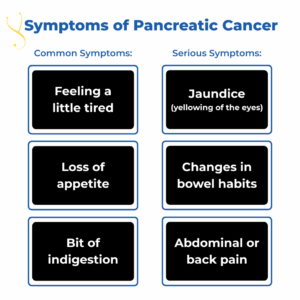
Symptoms of Pancreatic Cancer
When symptoms of pancreatic cancer do arise, they’re often vague and non-specific, or may mimic common digestive issues. Some people simply feel a little tired, with loss of appetite or a bit of indigestion.
The more obvious and serious symptoms — jaundice (yellowing of the eyes), changes in bowel habits, abdominal or back pain — don’t begin until the disease has progressed.
And besides being hard to detect and diagnose, pancreatic tumors are notoriously aggressive — a major factor behind the question, “Why Is Pancreatic Cancer So Deadly?” Cells grow and spread vigorously, resisting many standard cancer treatments. Discovered in later stages, cancerous material may be perilously wrapped around a patient’s small intestine and stomach.
Because the pancreas abuts the small intestine, stomach, and part of the biliary tree, it’s tough to surgically remove pancreatic tumors. The surgeon must be able to excise the tumor with a wide margin, often calling for the removal of part of the stomach and small bowel. Surgery, as well as chemotherapy treatment, can make it difficult for patients to eat and thus damage their quality of life.
Understanding Your Potential Risk
If your family or friends have been touched by this cancer, you’ve no doubt wondered, “Why is pancreatic cancer so deadly?”
Although it’s more common in older adults, incidence rates are increasing across all age groups. But fortunately, pancreatic cancer is fairly rare:
- The lifetime risk of developing it is approximately 1.5%, or 1 in 67 people.
- In the most recently published data for North Carolina, the age-adjusted incidence rate for pancreatic cancer was 12.4 per 100,000 people annually (with men more likely than women to be diagnosed).
However, given the challenges of early detection, understanding your personal risk is critical. At higher potential risk are people who:
- Smoke
- Are obese
- Have excessive chemical exposure
- Have recurrent pancreatitis (frequently because of alcohol consumption, this country’s leading cause of pancreatic cancer)
- Have a certain rare genetic mutation
New Frontiers in Fighting Pancreatic Cancer
Researchers continually investigate a hopeful range of more accurate blood tests, screening methods, and imaging studies to improve early detection of pancreatic cancer.
Monoclonal antibody treatments and mRNA vaccines have also shown promise by targeting specific mutations in cancer cells. Checkpoint inhibitor medications may prove more effective than long-used chemotherapy regimens, which do a lot of collateral damage when they kill rapidly dividing cells. In the same way that a vaccine trains your body to attack flu viruses or pneumonia, scientists may soon discover a method to preferentially attack cancer cells.
So if you’re worrying, “Why is pancreatic cancer so deadly?” be practical. Worry about the things you can do something about, and do something about the things you can change:
- Minimize alcohol
- Don’t smoke
- Avoid chemical exposures
- Follow standard health screening regimens, such as mammograms and colonoscopies
In other words, focus on a healthy lifestyle, which of course supports your wellness in countless ways.
Your Signature Healthcare physician is here to help you on your longevity journey. Let’s talk soon!
Topics: