
Environmental Medicine: A Valuable Key to Your Health
Each of us imagines our home, workplace, and/or school as a safe haven. But hidden pollutants or toxins in your environment, such as mold and chemicals, might subtly undermine your health over time.
Environmental medicine takes an educated look at how these invisible dangers affect us. It applies a practical lens to commonplace elements in our daily environment that may negatively affect the human body.
What Is Environmental Medicine?
Environmental medicine studies environmental factors that enter the human body and imperil human health. These risks can come from air, water, food, soil, building materials, cleaning products, and a multitude of other sources and compounds.
Environmental medicine considers how to identify, assess, control, or prevent those threats. It connects the dots on areas often overlooked: why some homes trigger asthma, how low-level chemical exposure adds up over time, or why certain workplaces leave people headachy or chronically fatigued.
More clearly each day, environmental medicine specialists, including scientists right here in North Carolina, note the chemical, physical, biological, and psychosocial impact the exposome (the composite of our lifetime exposures) has on humans.
Your exposome can determine your state of health, susceptibility to disease, and aging processes.
Environmental Medicine Considers Your Surroundings
Day by day, we’re all exposed to hazards we have little control over. It’s difficult, if not impossible, to avoid the many different chemicals and compounds in our soil, water, air, and work environments.
But before you panic and choose to live in a bubble, stay grounded. Not every vague symptom is caused by “hidden toxins,” and the field of environmental medicine often attracts exaggerated claims online.
Promisingly, the medical community has begun to embrace the concept of environmental medicine.
In treating patients, your Signature Healthcare physicians recognize certain symptoms deserve a look beyond the traditional considerations of genetics and lifestyle, perhaps leading us to ask, “What in your environment may be causing this? And how do we help you remove or reduce the threat?”
With your physician’s support, you can limit your exposures and the harm they cause.
Common Environmental Health Exposures
Simple items useful in our daily life can be double-edged swords. Regular contact with them may undermine your health.
Remember the weed-fighter Roundup? It was effective at killing weeds but eventually became linked to certain cancers in humans. Similarly, there are concerns that pesticides might create the risk of Parkinson’s disease or affect neurologic development in youngsters.
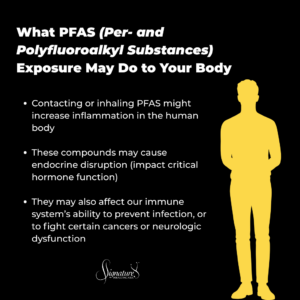
And much current research addresses the inherent long-range health risks of the per- and polyfluoroalkyl substances (PFAS) that persist in our nonstick pots and pans, seat-cushion covers, and carpets:
- Contacting or inhaling PFAS might increase inflammation in the human body.
- These compounds may cause endocrine disruption (impact critical hormone function).
- They may also affect our immune system’s ability to prevent infection or to fight certain cancers or neurologic dysfunction.
How Your Primary Care Physician Can Help
At Signature Healthcare, our concierge physicians are here to steer you toward trustworthy environmental resources. We also help you focus on reasonable, rational measures to reduce potential risks at home or at work.
We help you find good environmental resources
I recommend the website of the Environmental Working Group, an independent organization that evaluates and provides reliable information on a range of environmental factors, from water quality to cosmetic use to household cleaner use.
However, it would be daunting to tumble down the rabbit hole and try to follow every piece of advice on the EWG’s website. Pick your battles. Focus on content you find especially relevant to your family’s health, then follow EWG’s recommendations to limit potentially hazardous exposures.
The EWG can help you be selective about the products you use around your home:
- Take a look at cleaning agents rated safest for your kids and pets.
- Obtain information on your town’s water quality, then follow EWG advice on effective water filters for your home and family. Here in Mecklenburg County, our water quality is good, but a highly rated water filter can help you feel doubly protected.
- If painting your home or office, look for low- or no-VOC paint. VOCs (volatile organic compounds) deliver that fresh-paint or new-carpet scent… a smell that’s bad for us. VOCs can contribute to headaches, irritation, and long-term health risks.
- Mold exposure has been linked to respiratory issues and can aggravate conditions like asthma.
We consider your environmental history
Few medical schools today train new doctors in environmental medicine. They learn to explore the patient’s exposome, those lifelong exposures that may contribute to the individual’s physical condition. If you have complex, unexplained symptoms, it can be enlightening for your doctor to review your environmental conditions or history.
Some people have multiple chemical sensitivities, for instance. While detecting them is a highly specialized field outside the scope of our practice, your Signature Healthcare team can help you understand certain hazardous components (stain repellents, new-carpet compounds, plastics) and avoid exposures that might affect you in the long term.
For example, here are a couple of tips I give my patients:
- Avoid letting chemicals from plastics leach into your food. If you purchase food wrapped in plastic, remove the plastic at home and place it in a glass or ceramic container. Also, avoid microwaving foods in plastic containers.
- Lean organic in the foods you eat, especially those you eat regularly. The vital benefits of vegetables and fruit are clear, so enjoying high-quality produce is important, even if it is not always organic. If you enjoy strawberries and eat a lot of them in season, choose organic. Frozen organics are less pricey than fresh and yield the same nutritional benefits.
- Stay vigilant about the impact of chemicals in the products you use. For example, handle garden and lawn care products carefully. Request that lawn services use the safest available products to protect not just the landscape but also groundskeepers and the surrounding community.
Also worth noting is the potential effect of climate change on our health. For example, scientists have noted an increase in vector-borne illnesses, such as tick-borne diseases.
We can all be activists to better our environment:
- Contact your government representatives and ask for their continued attention to environmental hazards.
- Actively support legislation that helps you, helps your neighbors, and benefits our planet.
When to Contact Your Doctor
Are you concerned that an element of your current environment might affect your health or your family’s? Here’s when to consult us for treatment or for a referral to an environmental medicine specialist:
- If you have varied symptoms or believe you have multiple chemical sensitivities, seek a specialist with relevant expertise. Your Signature Healthcare doctor can guide you to the right one for your situation.
- If you’re suddenly exposed to a high concentration of mold or find yourself around it frequently, you may experience acute upper respiratory symptoms, a recurrent infection, or breathing difficulty. These are all reasons to see your concierge physician or a specialist we recommend.
Still asking “What is environmental medicine?” Want to know more about how environmental medicine can contribute to your healthy life and longevity?
Our team is happy to answer your questions. Let’s schedule some time.

Dr. Russ Greenfield
Dr. Greenfield was among the first physicians to train under the direct guidance of Dr. Andrew Weil and has been practicing Integrative Medicine for over 25 years. He is Board Certified in Emergency Medicine and Lifestyle Medicine.
 Membership Payment