

Have you had a mammogram lately? If so, you may receive a post-visit letter stating that your mammogram results show “extremely or heterogeneously dense breast” tissue.
What is dense breast tissue? Should you be alarmed? Does dense breast tissue require any action?
What Is Dense Breast Tissue?
First, let me put your mind at ease: Dense breasts are common and normal. Fifty percent of all women have them.
The human breast contains two types of tissue, glandular and fatty. Glandular tissue makes the breast dense. The more glandular tissue you have (and the less fatty tissue), the denser the breasts.
As of 2024, federal law requires mammogram reports to indicate breast density. In our state, the requirement dates back to 2014, when North Carolina law (Session Law 2013-321) began requiring every woman who has a mammogram to be informed of her breast tissue type and its potential impact.
But if you’re not aware that dense breasts are a common condition, your mammogram report may cause you some anxiety, or you may wonder why you’ve never heard about breast density before.
Here’s why it’s important:
- The denser the breast, the harder it is for a standard mammogram to detect small abnormalities in your breast tissue.
- Having dense breasts may elevate your risk of breast cancer:
- Half of all adult women have dense breasts, making them about twice as likely to develop breast cancer compared to women with average breast density.
- The 10% of women with extremely dense breasts are five to six times more likely to develop breast cancer than those with very fatty breasts (the least dense type).

What Causes Dense Breast Tissue?
Patients often want to know why they have dense breasts and if they can change it.
A woman’s breast density changes naturally over time:
- Younger women have more glandular tissue, which tends to lessen with age.
- 50 to 60% of women under age 45 have dense breasts, compared to about 20–30% of women over 70.
Also, hormone replacement therapy (estrogen, progesterone) activates glandular tissue, which can increase breast density.
What Should Be Done About Dense Breast Tissue?
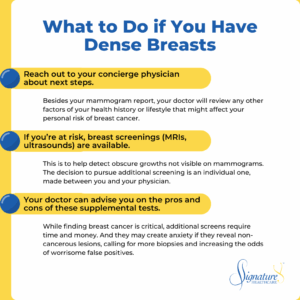
If your mammogram results show you have extremely or heterogeneously dense breasts, here’s what you can do:
- Reach out to your concierge physician about next steps. Besides your mammogram report, your doctor will review other factors of your health history or lifestyle that might affect your personal risk of breast cancer.
- Depending on your risk factors, additional breast screenings (MRIs, ultrasounds) may be offered to help detect obscure growths not visible on mammograms. The decision to pursue additional screening is an individual one, made between you and your physician.
- Although there are no standard guidelines, your doctor can advise you on the pros and cons of these supplemental tests. While finding breast cancer is critical, additional screens require time and money. And they may create anxiety if they reveal non-cancerous lesions, calling for more biopsies and increasing the odds of worrisome false positives.
Empower Your Breast Health
When it comes to breast health, knowledge is power.
Your breast density on a mammogram isn’t related to the firmness or size of your breasts, and it can’t be detected on a physical exam. Only a mammogram can determine if breast tissue is dense.
If your mammogram indicates dense breasts, it’s not a cause for apprehension. Rather, your results empower you to:
- Be vigilant with your own self-exams.
- Speak with your doctor to understand any personal risks you may have.
- Consider additional screening if appropriate.
At Signature Healthcare, we’re often asked questions like:
- What is dense breast tissue?
- What causes dense breast tissue?
- What should be done about dense breast tissue?
We’ve got your answers. Reach out for a consultation and empower yourself.
Topics: